
June 2010 Archives
Bottles
By Jocelyn Paine on June 30, 2010 7:24 PM

for Dr. Dobbs
Convergence to a Pint
By Jocelyn Paine on June 26, 2010 4:34 AM
An infinite number of mathematicians walk into a bar.
The first one says: I’ll have a pint.
The second one says: I’ll have half a pint.
The third one says: I’ll have a quarter of a pint.
The fourth one says: I’ll have an eighth of a pint.
The barman holds his hand up for silence, says “I hate you guys”, and
pours out two pints.
Posted by Laurent Wright to the Microsoft Excel Developers’ List EXCEL-L.
No Earthly Power
By Jocelyn Paine on June 23, 2010 5:22 PM
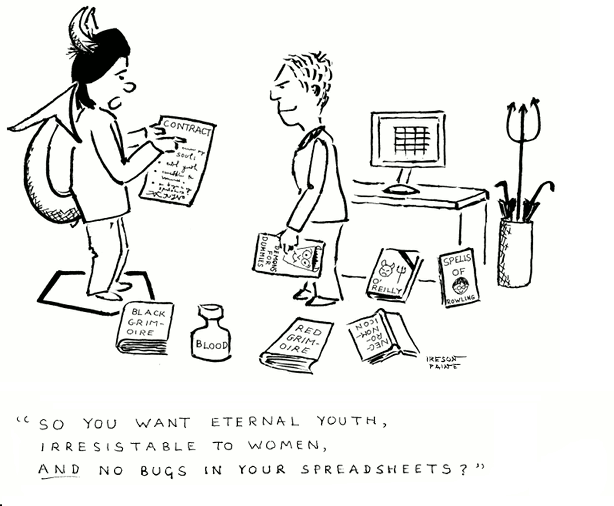
for Dr. Dobbs
MS Fnd in a Lbry
By Jocelyn Paine on June 21, 2010 8:06 AM
Here’s a story about the perils of indexing and
digital encoding: Hal Draper’s
MS Fnd in a Lbry.
It’s one I’ve never forgotten, having
found it
when I was twelve,
in Groff Conklin’s
anthology 17 X Infinity.
There,
it was introduced by
a reference to
Richard Feynman’s 1959 talk
There’s Plenty of
Room at the Bottom,
in which he asks Why cannot we write the entire 24 volumes of the
Encyclopedia Britannica
on the head of a pin? To get yourself in the right
frame of mind, read that first.
for Dr. Dobbs
How NOT to Use Excel
By Jocelyn Paine on June 18, 2010 8:18 PM
If you’re researching into spreadsheets or other
visual programming languages, or if you’re teaching
Excel, or if you just want to know which aspects of Excel really bother
spreadsheet developers,
you may like my new
How
NOT to Use Excel blog. It came about
as a result of Don McMillan’s hilarious video
about How
NOT to use Powerpoint that I posted about in May.
Mr. Excel
By Jocelyn Paine on June 16, 2010 5:37 PM

Unicode and the Shavian Alphabet
By Jocelyn Paine on June 14, 2010 4:42 AM

With ten tentacle tips effortlessly
keeping track of the goto’s and their destinations in his
spaghetti Hello World program, Fnork
cannot understand why mere Earthlings
have so much trouble with labels. For
last week’s cartoon
Labels,
I wanted a convincingly alien
writing system for Fnork’s programming
language.
But I didn’t want to use Armenian or
Georgian or Telugu, beautiful
though they are. Or Tamil, which I’ve always
thought of as
visual jazz, all neon lights
and Rhapsody in Blue made graphic.
Some reader would be bound to recognise them
as real scripts. So
I used the Shaw
alphabet.
The History and Benefits of Ada
By Jocelyn Paine on June 10, 2010 8:15 AM
I’m off to the Royal
Statistical Society in London today to meet
my friend
Graham Stark when he talks about
economic modelling
at the Family
Resources Survey User meeting.
In Ada, we — Graham did most of it, actually — have written an economic model
for the
Office of the Scottish Charities Regulator
to help them decide
whether prospective charities are entitled
to become actual charities. A charity must
benefit a reasonable proportion of the population,
and if its services are too expensive, it
won’t do so. So
as Graham explains in
these papers,
the charity must be “affordable”. Stan’s Super
Gym and Spa Club wants to become a charity, but
charges £600 a year membership: is that affordable?
It’s to answer such questions that we are using Ada, to
analyse the Government’s
Family
Resources Survey of family incomes, and hence work out
what various kinds of family can afford.
Labels
By Jocelyn Paine on June 9, 2010 4:36 AM

The End-User and the Expert Artisan
By Jocelyn Paine on June 7, 2010 2:00 PM
Lord Finchley tried to mend the Electric Light
Himself. It struck him dead: And serve him right!
It is the business of the wealthy man
To give employment to the artisan.Hilaire Belloc
I’ve always liked this little poem,
and was reminded of it last week when I came
across it in Bernard Levin’s essay
Easy as a, b, d. He discusses the
presumptuousness of assuming that just because
one can write a book, one can also index it.
End-users are not necessarily wealthy;
but perhaps a version of the poem should be
composed for those who assume that just
because they can write an equation, they
can also spreadsheet it. One might begin
with the notorious spreadsheet holding 179 “hidden”
Lehman contracts which accidentally got
unhidden, and thereby included in Barclays’s purchase of
Lehman’s assets — as
Debra Cassens Weiss
reported on October 16th 2008 for
the American Bar Association Journal:
Excel Error by a Cleary Gottlieb
Associate Alters Lehman Asset Deal.
Demonstrating a Mini-Compiler with a Stack-Machine Program that Calculates Factorials
By Jocelyn Paine on June 1, 2010 11:09 AM
In
Stack
Machines, Expression Evaluation, and the Magic of Reverse
Polish,
I showed how expressions can be evaluated by
rewriting them in reverse Polish and translating this
into machine-code instructions for a stack machine.
I demonstrated with a stack-machine interpreter
that I’d written as part of a working model
of a Pascal compiler. But as well as expressions,
the compiler needs to compile assignments and jumps,
so — in my progress towards
explaining the compiler —
I’m going to extend the machine code so it can
handle these. I’ll demonstrate by
interpreting a program
that calculates five factorial.


Search
About this Archive
This page is an archive of entries from June 2010 listed from newest to oldest.
May 2010 is the previous archive.
July 2010 is the next archive.
Find recent content on the main index or look in the archives to find all content.


